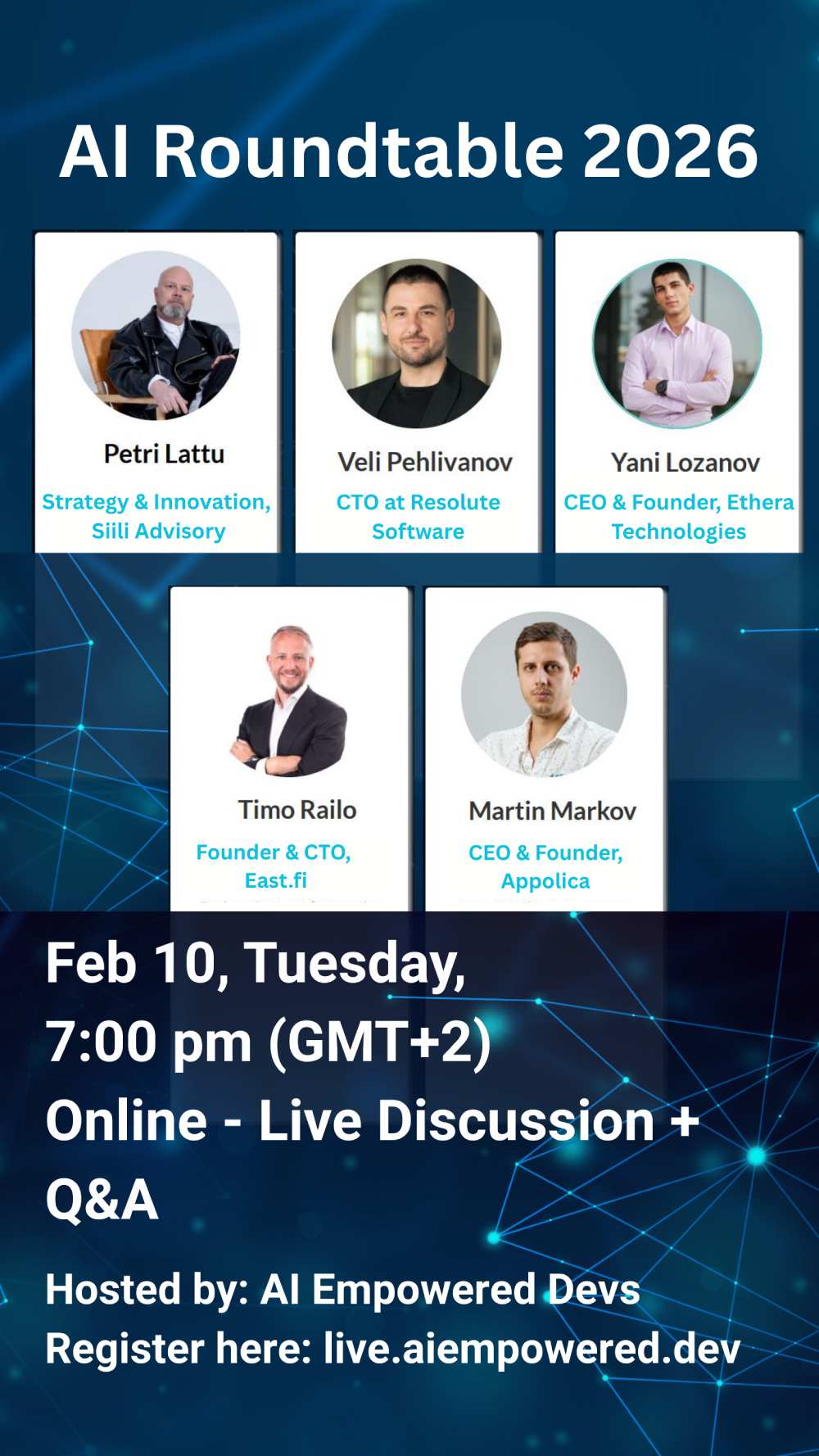

Dates
Jan 27, Feb 3, Feb 10, Tuesdays
Time
7:00 pm - 8:00 pm (GMT+2)
Format
ONLINE - 3 live sessions + Q&A (English)
Because I want to see a real, repeatable and production-grade approach
Seats are limited.

AI helps for 15 minutes, then you lose 2 hours fixing subtle bugs
It works on toy demos, fails on a real repo with real constraints
You don’t have a clear way to structure prompts, so results are inconsistent
You don’t know how to evaluate quality, beyond “looks ok to me”
You don’t trust AI-generated code - and you’re not sure when you should
Everyone in the team has their own “prompt style” - nothing scales
The space is full of noise and hype, but short on real, repeatable practices
Leadership asks “ROI?” and you have nothing solid to show
A repeatable AI-first coding workflow that produces reviewable PRs (not “magic code dumps”)
How to review AI output using diffs and guardrails so quality stays under control
How to design code and architecture that AI can safely extend over time
Where AI succeeds, where it fails, and how to reduce the failure rate
What’s changing for engineers and teams - and what skills matter next
Most Importantly:
This is not “prompt tricks”.
It’s engineering: workflows, constraints, review patterns, and long-lived codebase thinking.

Because I want to see a real, repeatable and production-grade approach

Jan 27, Tuesday
7 pm GMT+2
Online
60-minute session
English
What “98% LLM-written code” actually means (and what it doesn’t)
Tooling stack & daily loop (CC, Codex, reviews, diffs)
What we have built recently, some live examples
How does my day-to-day coding work look these days
What is fast becoming obsolete
When AI succeeds, and when it fails
Measuring impact: volume vs quality vs leverage
Key Takeaway:
AI is already a productivity multiplier if you treat it like a capable engineer with an incurable amnesia.
Walk away with full understanding of what is possible with AI today and what skills you need

Feb 3, Tuesday
7 pm GMT+2
Online
60-minute session
English
How to design codebases AI can safely extend
Context management: slicing reality so models stay correct
Workflow examples (agentic where useful, constrained where risky)
TDD/DDD/modularity - what helps, what’s dogma
Key Takeaway:
How to design architecture and workflows for LLM first development.
Learn how to make your codebase AI-friendly so speed increases without sacrificing long-lived maintainability

Feb 10, Tuesday
7 pm GMT+2
Online
60-minute session
English
Skills that suddenly matter (and what’s becoming obsolete)
Seniors vs juniors with AI - what actually happens
How org change fails (and how to make it stick)
New business models enabled by small high-leverage teams
Key Takeaway:
Prepare for the new world order without hype.
Get a practical map of how roles shift, what to learn next, and how to adopt AI without breaking your org
Because I want to see a real, repeatable and production-grade approach
You write production code and want real leverage, not hype
You work in an existing codebase and care about maintainability
You want a workflow you can repeat every day, not “random prompting”
You want adoption patterns that scale across a team
You need quality guardrails and measurable impact
You want to know what to invest in (skills, process, architecture) for the next 6-12 months
Because I want to see a real, repeatable and production-grade approach
Not a “prompt engineering secrets” session
Not toy demos only
Not “AI replaces engineers” nonsense
Not theory without production context
Not a sales pitch (tools may be mentioned only as real examples)


Connect with Timo:
Timo Railo is a senior software engineer, technical founder, and CTO with 30+ years of hands-on experience building production systems across web, mobile, data, and infrastructure. He is the Founder and CTO of East.fi, a matchmaker between Nordic and Eastern Europe. He has built a few companies and lots of software over the years.
Over the last year, Timo has transitioned his daily work to AI-first workflows, reaching ~98% of the new code written with LLM assistance, measured across real production repositories. His focus is not “prompt tricks”, but repeatable engineering workflows, guardrails, and architectural patterns that make AI usable in long-lived codebases.
Previously, Timo has built and used multiple low-code and tooling platforms and has always been a big believer in configuration over code. His current work sits at the intersection of professional software engineering, AI tooling, and organizational change, with a strong bias toward pragmatism over hype.
Because I want to see a real, repeatable and production-grade approach
Practical. Production context, workflows, guardrails, review patterns, and real examples.
No. Principles apply across stacks.
If you’re brand new to software engineering, it may be too advanced. If you’re a working dev (or lead), you’ll get value.
Yes, but the series is designed to stack: workflow -> architecture -> roles and adoption.
Yes. Live Q&A in every session.
Yes, The 3-part Live Webinar series is free and we hope you get maximum actionable insight.
The recordings will be available only inside the AI Empowered Devs community (may change).
AI Empowered Devs is a members only community for developers and tech leaders who want to use AI in real software engineering - not just play with tools.
The goal is practical: share what actually works in production, what breaks, and how to adopt AI without sacrificing code quality.
We are starting on 20th of Jan. 2026 and already have 80+ signed up members for the pilot phase. We will be using this phase to test formats, collect feedback, and refine what delivers the most value - before opening officially.
A place where developers help developers with real workflows, examples, and honest feedback
A signal-heavy environment (less hype, more proof)
Repeatable formats that improve skills fast: show-and-tell, teardown sessions, implementation clinics, and Q&A with practitioners
Networking with devs, CTOs, and founders who are actually building with AI
Guest speakers and practitioners (like this series) sharing real workflows and lessons learned
Members sharing wins, tools, patterns, and failures so others don’t repeat them
A growing library of practical resources (playbooks, checklists, prompts with guardrails, workflows)

Follow us on:
Facebook
LinkedIn
Youtube
Instagram
TikTok